Accounts Receivable Financing That Moves Fast
We offer accounts receivable financing that turns your unpaid B2B invoices into cash in days, so slow-paying customers don't slow down your business.
Apply NowWe're a Funding Partner
with a Proven Track Record
Since 2008, we've grown with the companies we support.


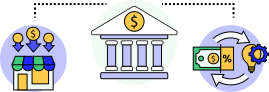
How Does A/R Financing Work?
A business can “sell” its outstanding invoices to a financing company in exchange for a cash advance. On the upside, your credit score often plays a smaller role. There are two main approaches: a/r financing and factoring. Each has potential drawbacks, which we’ll explore in greater detail below.
Accounts Receivable Financing Tailored to Your Needs

Your A/R Financing at a Glance
| Advance Amount |
|
|---|---|
| Repayment |
|
| Requirements |
|
| Funding Time |
|
 70% to 90% of each invoice upfront
 Scales with your outstanding receivables
 When your customer pays the invoice
 B2B invoices on net terms
 Time in business 6+ months
 570 FICO score
 $240k annual revenue
 Within 24 hours of invoice verification
How Does Accounts Receivable Financing Compare?
Do You Qualify for Accounts Receivable Financing?
When exploring financing options with Fora Financial, companies must meet a specific criteria. Here’s an overview of the minimum requirements you can expect.

| Time in Business | Minimum 6 Months |
|---|---|
| Business Annual Growth Revenue | $240K+ Annual Revenue |
| Business Checking Account | Yes |
| US Citizen/Based Company | Yes |
| FICO Score | 570+ |
| Other Financing | None |
| Bankruptcies | None open |
Get Accounts Receivable Financing Today

1
Apply
Submit the easy online application within minutes and a Capital Specialist will call to discuss your funding request.

2
Get A Decision
You will receive your approval status in as little as 4 hours after submitting all necessary documentation.

3
Receive Your Funds
You'll receive a lump-sum payout in as little as 24 hours of offer acceptance. Spend it at your own pace, as you need it.
When to Use Accounts Receivable Financing
A/R financing works best when there's a mismatch between when you invoice a customer and when you actually need the cash. These are four of the most common scenarios Fora Financial sees.
-

Managing Cash Flow Gaps
A/R financing provides quick access to funds, allowing businesses to cover daily expenses like payroll, rent, and utilities without waiting for customer payments.
-

Funding Marketing and Expansion Efforts
Say yes to a larger order, launch a new campaign, or open a second location without waiting on receivables to close. Turning invoices into working capital lets you act on opportunities as they show up.
-

Covering Operating Expenses
Payroll, rent, and utilities can't wait for a customer to pay on net 60 terms. A/R financing frees up cash already tied up in your open invoices, so day-to-day operations don't stall.
-

Case Studies

Bridging the Receivables Gap
-

Funding Amount: $150,000
-

Industry: Construction
-

Use of Funds: Working Capital, Bridge Financing

Bridge Capital on Bonded Contract
-
Funding Amount: $500,000
-
Industry: Engineering & Infrastructure
-
Use of Funds: Bridge Capital
Jobs on Deck, Cash Running Thin
-
Funding Amount: $40,000
-
Industry: Furniture Installation
-
Use of Funds: Bridge Financing, Working Capital

Delivering Certainty
-
Funding Amount: $1,000,000
-
Industry: Manufacturing — Transmission Solutions
-
Use of Funds: Liquidity Support, Bridge Funding

Strategic Recapitalization
-
Funding Amount: $5,000,000
-
Industry: Manufacturing — Building Products
-
Use of Funds: Partner Buyout & Debt Recapitalization

Supporting Growth
-
Funding Amount: $135,000
-
Industry: Security Services
-
Use of Funds: Bridge Financing, Debt Consolidation
Bridging Progress
-
Funding Amount: $1,500,000
-
Industry: Construction
-
Use of Funds: Project mobilization, upfront operating costs

Featured Funding
Bridge Funding
-
Funding Amount: $2,000,000
-
Industry: Construction
-
Use of Funds: Bridge funding
What Sets Us Apart from the Rest
Accounts Receivable Financing FAQs
-
Accounts receivable (A/R) financing allows businesses to use their unpaid invoices as collateral for a line of credit. This type of financing may help you cover expenses or invest in growth without waiting for customer payments.
-
A/R financing and factoring both use outstanding invoices to access working capital, but they work differently. With A/R financing, you retain ownership of your invoices and collect payment from customers yourself. The lender simply advances funds against the receivables as collateral. With factoring, you sell the invoices outright to the factor at a discount. The factor takes over collections and your customers pay the factor directly. A/R financing is generally preferred when maintaining the customer relationship and payment experience matters. Factoring can work well when offloading collection responsibility is the priority, but it typically comes with higher fees and customer notification requirements.
-
A/R financing is most useful for B2B businesses that invoice other businesses and regularly wait 30 to 90+ days for payment. The industries where it comes up most frequently are staffing and workforce solutions (where payroll is due weekly but client invoices settle monthly), freight and transportation (where loads are delivered before freight bills clear), wholesale and distribution (where large orders are shipped on net terms), manufacturing (where materials and labor are paid before finished goods are delivered and invoiced), and B2B professional services where project completion precedes payment by weeks or months. Construction operators working on longer project timelines also use A/R financing, though construction-specific invoice structures may affect eligibility.
-
Eligible receivables are generally invoices from creditworthy customers with clear payment terms. Invoices should be free of liens or prior claims and should not be subject to disputes. Often, only business-to-business (B2B) invoices qualify, while consumer debt and invoices over a certain age may not.
-
Key benefits include:
- Improved cash flow without waiting for customer payments.
- Quick access to capital to cover operational costs or seize growth opportunities.
- No additional debt, as it's a financing solution based on assets rather than a loan.
- Easier qualification for businesses with strong receivables, even if their own credit may not be ideal.
-
Funds are typically accessible within 24 hours after invoices are submitted and verified, providing a fast solution for businesses needing immediate cash.
-
The cost of accounts receivable financing varies based on your customer’s creditworthiness, the invoice amount, payment terms, and how quickly the invoice is expected to be paid. Your Capital Specialist will walk through the full cost breakdown before you accept any offer so you can evaluate it clearly.
-
It can, depending on the structure. In factoring, customers may be aware of the financing arrangement and may be contacted by the factor directly for payment. In financing, where the business retains control of collections, the impact on customer relationships is minimal.
-
Most financing companies advance between 70% and 90% of the invoice value upfront. The remaining amount, minus fees, is paid once the invoice is settled by the customer.
-
Fora Financial works with established B2B businesses across a wide range of industries. A/R financing is commonly used in staffing, freight and transportation, wholesale and distribution, manufacturing, and B2B professional services. Some invoice types are handled differently or may not qualify, including construction progress billing invoices, medical receivables, government-issued invoices, and invoices subject to active disputes or liens. If you’re unsure whether your invoices qualify, a Capital Specialist can review your receivables profile before you apply.
-
Accounts receivable financing through Fora Financial is a lending product. You retain ownership of the invoices and repay the advance when your customer pays. This is distinct from factoring structures. If you are specifically evaluating recourse versus non-recourse factoring, speak with a Capital Specialist about whether a factoring or A/R financing structure is the better fit for your invoice profile and risk tolerance. In a non-recourse factoring arrangement, the factor assumes the risk if the customer does not pay. In a recourse arrangement, you remain liable if the customer defaults. The structure affects both pricing and risk allocation.
-
In most A/R financing arrangements, if the underlying customer does not pay the invoice, the business that obtained the financing remains responsible for repaying the advance (this is called a recourse structure). Non-recourse arrangements, where the lender absorbs the loss if the customer doesn’t pay, typically carry higher fees to offset that risk. Your Capital Specialist will confirm which structure applies to your offer and what happens in the event of a customer default before you sign anything.
Get Financing Today
Apply online in minutes and get an approval decision for your small business funding in as little as 4 hours.